
The problem is upstream
AI coding agents are good now. Point Claude Code at a repo and it will write real, working code. That isn't the problem. The problem is what the agent can see.
A coding agent works from two things: the local repo and whatever the individual developer types into it. It can't see the architectural decision the team made on a planning call last week. It can't see why you chose Postgres over Dynamo, or that "done" means something specific on this team, or the three edge cases someone already raised and resolved. All of that lives in private heads and closed conversations the agent will never read. So it does the locally reasonable thing, which is often the globally wrong thing.
Now multiply that across the team. Five engineers, five agents, five private sessions, five interpretations of what the feature should actually do. Each agent is powerful and each is working blind. They produce five locally sensible implementations that don't agree, because none of them was grounded in the same shared understanding. The best thinking on the team never reaches the code, because there was never a shared place for the thinking to live.
The real cost isn't the tokens. It's that the planning and the context, the part that determines whether the code is right, happens in isolation or doesn't happen at all. Good code doesn't come from one developer's faster guess, or one agent's. It comes from consensus on what you're building, reached before you build it.

The shift: planning together with Wind Stream, build in Claude Code
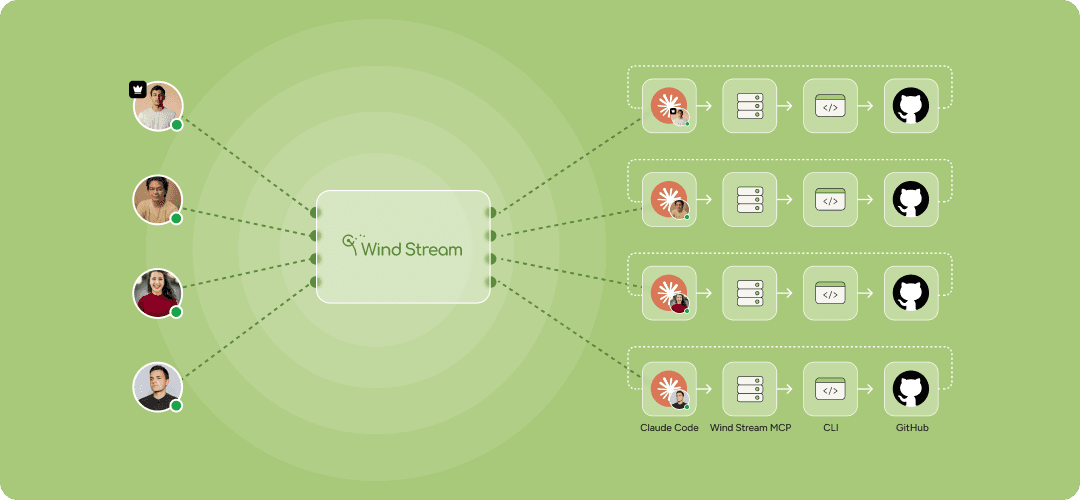
Wind Stream is where the team does the thinking. Claude Code is where the code gets written. The Wind CLI connects them.
It works like this. A feature lands. Before anyone writes code, the team works the high-level decisions together in a Wind Stream session, the architectural choices like Azure versus AWS, the shape of the data model, what the feature actually needs to do. As the planning sharpens, you use Branches to break the high-level design into focused, compartmentalized specs, each one carrying the full context of the discussion it came from. By the time something is code-ready, the team has reached consensus, and that consensus is written down in a shared session rather than trapped in one person's head.
Then you move to Claude Code. The wind CLI handles the setup, authentication, session config, and connecting the agent to Wind Stream, following a "don't make me think" principle so a developer is running in a couple of commands. Once connected, the agent can reach back into Wind Stream and pull the team's decisions directly: search what a teammate concluded in an earlier session, the exact wording the team agreed on, the spec that came out of planning. The code that gets written is grounded in organizational knowledge, not just the local repo, and the developer never has to copy and paste context across tools to make that happen.
It runs both directions. The work happening in Claude Code flows back into a shared Wind Stream session the whole team can see, so the coding isn't invisible anymore either. The result: the code comes after the conversation, and it reflects what the team actually decided.
What changed
Engineering teams running the Wind Stream + Claude Code workflow see
Agents grounded in team context. The coding agent pulls the team's actual decisions and specs from Wind Stream, so it builds what the team agreed on, not what it guessed from the local repo.
Planning happens before code, together. High-level architecture and specs get worked out in shared sessions and broken into focused branches, so "code-ready" actually means ready.
No copy-paste context tax. Decisions, wording, and prior reasoning flow between Wind Stream and Claude Code through the wind CLI. Nobody is pasting context from one tool into another.
The work stays visible across every time zone. Coding sessions surface back into Wind Stream so every engineer, regardless of when their day starts, sees what was built, why it was built that way, and what comes next. No reconstructing context from Slack at standup.
Async catch-up without the interruption cost. The sidebar lets anyone get up to speed privately inside the session. New hires, distributed teammates, engineers picking up a thread mid-sprint: they read the session instead of scheduling a call. - Oversight by design. Review where the code is unfamiliar, auto mode where context is deep. Speed and control, not a trade-off between them.
A real story
"I stopped paying for the same context five times over. We'd have five engineers, five ChatGPT windows, five versions of the same feature spec floating around. Now we write the spec together, everyone sees the same prompt, and the output is closer to what we need the first time. The junior engineers have learned more about prompt craft in two weeks of shared sessions than they did in two months of private ones."
— Engineering Lead, B2B SaaS, 20+ person engineering team